


Red Light vs. Blue Light vs. Infrared: What Each Wavelength Actually Does
Light therapy marketing throws numbers at you — 630nm, 660nm, 850nm — with no explanation of why they differ. Here's the short version.
Wavelength is really about depth
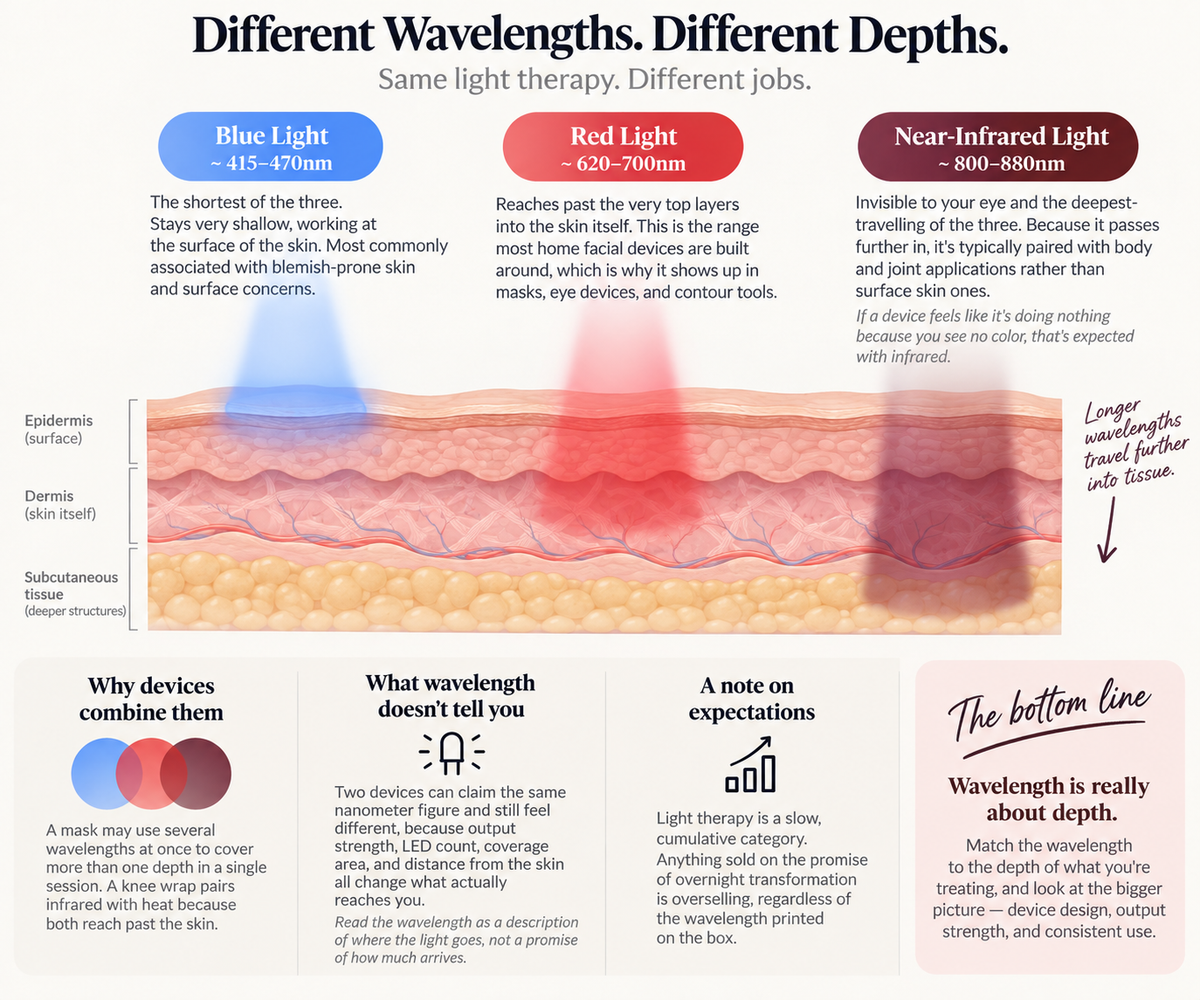
A wavelength is the size of a light wave, measured in nanometers. Shorter waves stop near the surface. Longer waves travel further into tissue. That single fact explains almost every difference between these light colors.
Blue light (roughly 415–470nm)
The shortest of the three. It stays very shallow, working at the surface of the skin, and is most commonly associated with blemish-prone skin and surface concerns.
Red light (roughly 620–700nm)
Reaches past the very top layers into the skin itself. This is the range most home facial devices are built around, which is why it shows up in masks, eye devices, and contour tools.
Near-infrared light (roughly 800–880nm)
Invisible to your eye and the deepest-travelling of the three. Because it passes further in, it's typically paired with body and joint applications rather than surface skin ones. If a device feels like it's doing nothing because you see no color, that's expected with infrared.
Why devices combine them
A mask may use several wavelengths at once to cover more than one depth in a single session. A knee wrap pairs infrared with heat because both reach past the skin. Matching the wavelength to the depth of what you're treating is the whole design logic.
What wavelength doesn't tell you
Two devices can claim the same nanometer figure and still feel different, because output strength, LED count, coverage area, and distance from the skin all change what actually reaches you. Read the wavelength as a description of where the light goes, not a promise of how much arrives.
A note on expectations
Light therapy is a slow, cumulative category. Anything sold on the promise of overnight transformation is overselling, regardless of the wavelength printed on the box.

Written by WANGWEI


Leave a comment
This site is protected by hCaptcha and the hCaptcha Privacy Policy and Terms of Service apply.